What if Europe’s windstorm experience of the last two decades is the exception rather than the norm? After a relatively benign period for losses between 2000 and today, it can be tempting to conclude that the risk has diminished. PartnerRe’s Catastrophe Research team tested this assumption by comparing observed windstorm history with a far broader set of plausible storm scenarios, helping to put recent experience into a longer-term risk perspective.
Can recent history give us a reliable view of Europe windstorm risk?
Observed losses vary significantly from decade to decade. The late 1980s and 1990s stand out clearly in the historical record, while the 2000s and 2010s appear much quieter by comparison. Yet even the 64-year record from 1960 to 2023 remains a limited sample for a peril with such high natural variability. For this reason, PartnerRe compares observed experience with a much broader stochastic view.
Annual Aggregate Europe Windstorm Losses: Modeled & PartnerRe As-if Industry Losses to 2026[1], [2]
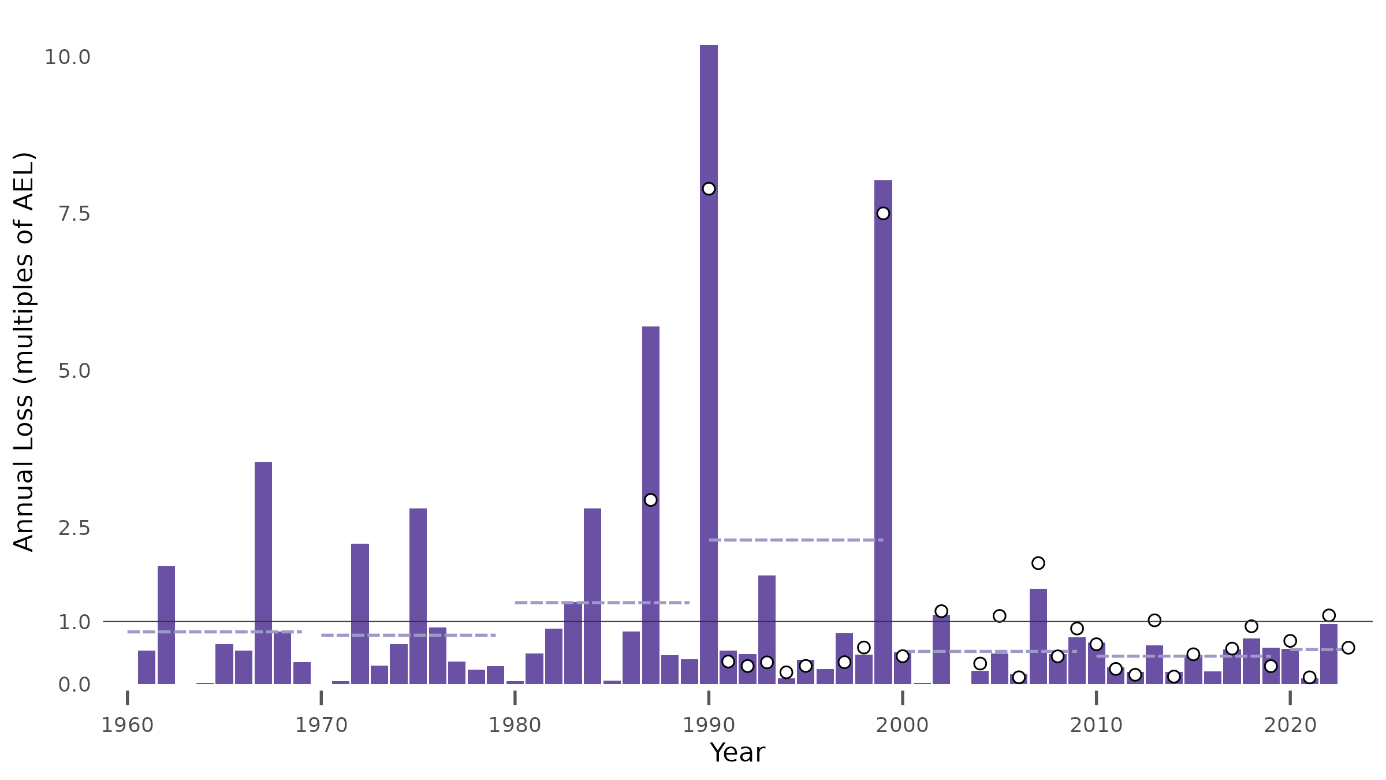
Figure 1: Annual aggregate historical modelled Europe windstorm losses based on CatFocus (bars), decadal means (dashed), and as-if 2026 losses (white filled circles). All losses are normalized by the annual expected loss (AEL), shown by the horizontal line. Both CatFocus and the as-if 2026 losses show strong inter-decadal variability, with the late 1980s and 1990s standing out against the more benign experience of recent decades. Source: PartnerRe
What does a 12,500-year view reveal about the variability of European windstorms?
Historical records show only what happened. To understand what could plausibly have happened, PartnerRe analyzed a stochastic catalogue representing 12,500 years of present-day Europe windstorm activity, which was developed in collaboration with Aon Impact Forecasting and the Karlsruhe Institute of Technology. A high-resolution version of the LAERTES[3] ensemble provides thousands of plausible alternative windstorm histories. The simulated storms were calibrated against observed wind speeds and historical losses, allowing the model to reproduce historic losses with good accuracy.
The expanded view reveals that Europe windstorm risk is highly variable, with quiet and active periods recurring throughout the simulations. The simulations, which were forced with changes in atmospheric greenhouse gas emissions, do not reveal a robust change of Europe windstorm risk caused by climate change. More in-depth studies suggest there could be regional changes in windstorm risk[4] [5] but consensus is limited[6]. This variability means that even several decades of observed history may not fully capture the range of possible outcomes.
The analysis also helps put recent experience into perspective. The highly active 1990s rank among the most extreme decades in the catalogue, while the quieter decades that followed, although unusual, remain within the range of plausible outcomes. This highlights the risk of drawing conclusions from any single historical period and underscores the importance of complementing observed losses with stochastic modelling when assessing long-term Europe windstorm risk.
A 12,500-Year Probabilistic Perspective on Decadal Europe Windstorm Variability
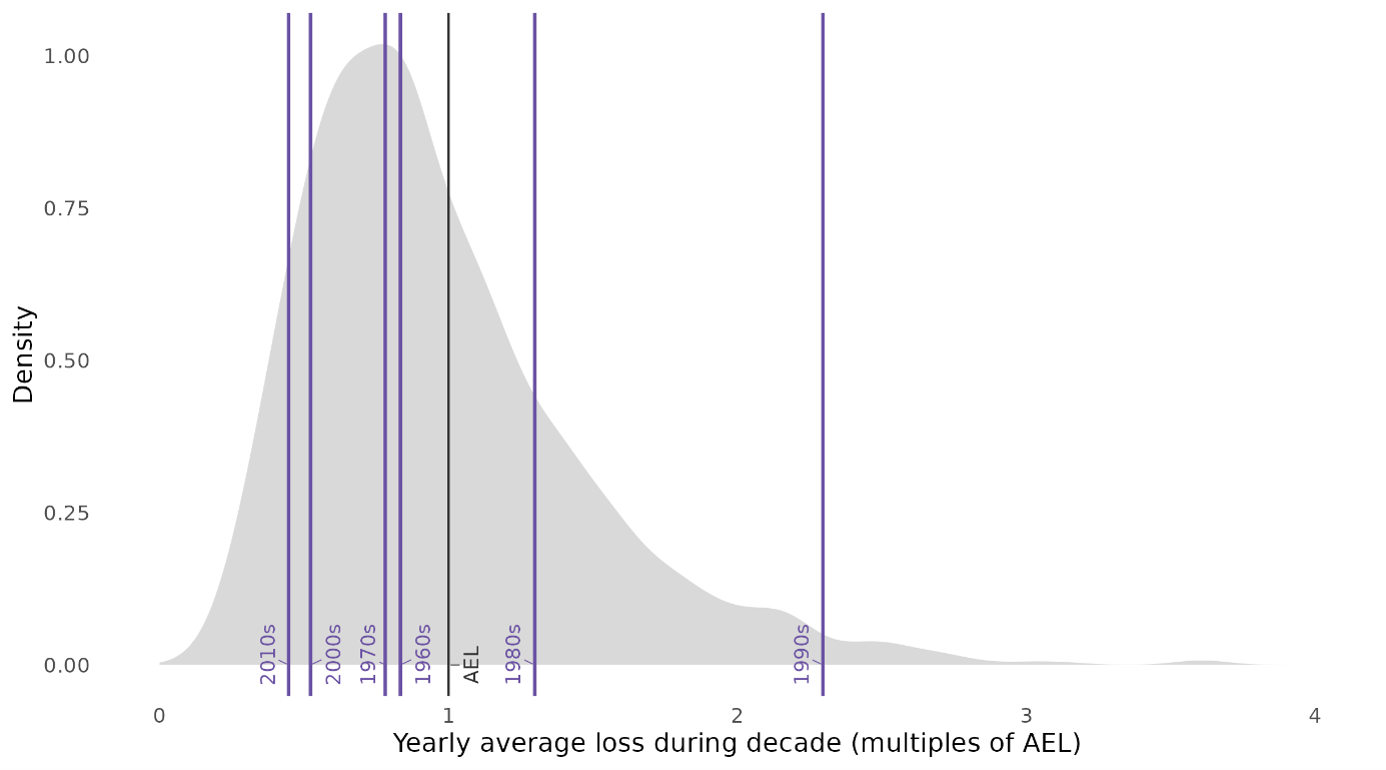
Figure 2: Each vertical purple line represents where a historical 10-year period fits within the grey probability distribution representing stochastic 10-year periods. The losses are normalized by the annual expected loss (AEL), shown in black. The comparison helps show whether observed decades were typical (close to 1), unusually quiet (less than 1) or unusually active (greater than 1). Source: PartnerRe
What can underwriters learn from a view of risk based on extensive simulations?
The recent lull in Europe windstorm activity should not automatically be interpreted as evidence that risk has declined as part of a longer-term change. Historical loss experience reflects only one of many possible outcomes of a highly variable peril, whereas stochastic modelling provides a broader perspective on the range of losses that could occur.
For example, although average losses of the 2000s and 2010s were around half of the long-term stochastic annual expected losses, the stochastic catalogue contains decades with even lower activity. The 2000s and 2010s sit at the 15th and 9th percentiles, respectively. Combining historical observations with long-term stochastic views therefore helps underwriters assess risk more consistently and avoid overreacting to naturally occurring active or quiet periods. This approach forms part of PartnerRe’s proprietary View of Risk.
Contact us
Understanding Europe windstorm risk requires looking beyond recent loss experience. If you would like to discuss the findings of this research, PartnerRe’s proprietary View of Risk, or the potential implications for your portfolio, please reach out to us.
Contributors
Marius Egli, PhD, Researcher, Catastrophe Research
Leonie Villiger, PhD, Researcher, Catastrophe Research
Niklaus Merz, PhD, Senior Researcher, Catastrophe Research
Paul Della-Marta, PhD, Head of Catastrophe Research
This article is for general information, education and discussion purposes only and does not in any way constitute legal or professional advice.
References
[1]PERILS Industry Loss Database. https://www.perils.org/products/industry-exposure-and-loss-database
[2]Munich Re NatCatSERVICE. https://www.munichre.com/en/solutions/for-industry-clients/natcatservice.html
[3]Ehmele et al. (2020) Earth System Dynamics. https://doi.org/10.5194/esd-11-469-2020
[4]Priestley et al. (2026), Environmental Research Letters https://doi.org/10.1088/1748-9326/ae845f
[5]Severino et al. (2024), NHESS. https://doi.org/10.5194/nhess-24-1555-2024
[6]Seneviratne et al. (2021), IPCC AR6 WG I Chapter 11. https://www.ipcc.ch/report/ar6/wg1/chapter/chapter-11/
