As accelerated underwriting (AUW) programs become increasingly common in Canada, the risk of substandard and declinable lives being issued as standard has become an important consideration for carriers.
In PartnerRe’s first AUW Insights[1], we identified decline misclassification as the main driver of mortality slippage in Canada. In this Quick Read, we look more closely at decline mortality risk, what US experience can tell us, and the implications for Canadian carriers as AUW programs continue to evolve.
Why does decline mortality matter?
In AUW programs, traditional underwriting requirements such as fluids testing are waived, which can result in substandard and declinable risks being issued as standard. In a whitepaper published by the US Life team at PartnerRe, US decline mortality data indicates there is more than meets the eye to the prevailing industry assumption of 500% relative mortality for declinable risks[2].
The misclassification of declined lives is increasingly becoming a major driver of mortality slippage across the industry and may account for up to 50-60% of overall slippage[3]. While data in Canada is somewhat limited compared with the US, there are common findings which create opportunities for Canadian carriers to strengthen risk mitigation efforts.
What should life insurance carriers pay attention to?
AUW programs vary significantly across carriers – different underwriting practices and customized tools and models can influence their respective ability to detect and manage overall decline risks.
Monitoring mortality slippage trends can be more meaningful when analyzed at a granular level over time (e.g. by gender, age, face amount bands, and product). For decline slippage, additional fields such as reasons for decline can help identify specific trends that aggregated results can overlook. These insights can create valuable feedback loops for underwriters and support refinements to AUW programs and predictive models.
What are implications of decline mortality risk for pricing?
Another key finding from the US whitepaper is that decline mortality shows a pattern similar to the shape observed in Simplified Issue (SI) products, which typically do not require fluids. SI mortality experience tends to exhibit elevated claims in the earlier durations, grading down over time as shown in Figure 1.
Decline Risk Actual/Expected Deaths by Duration
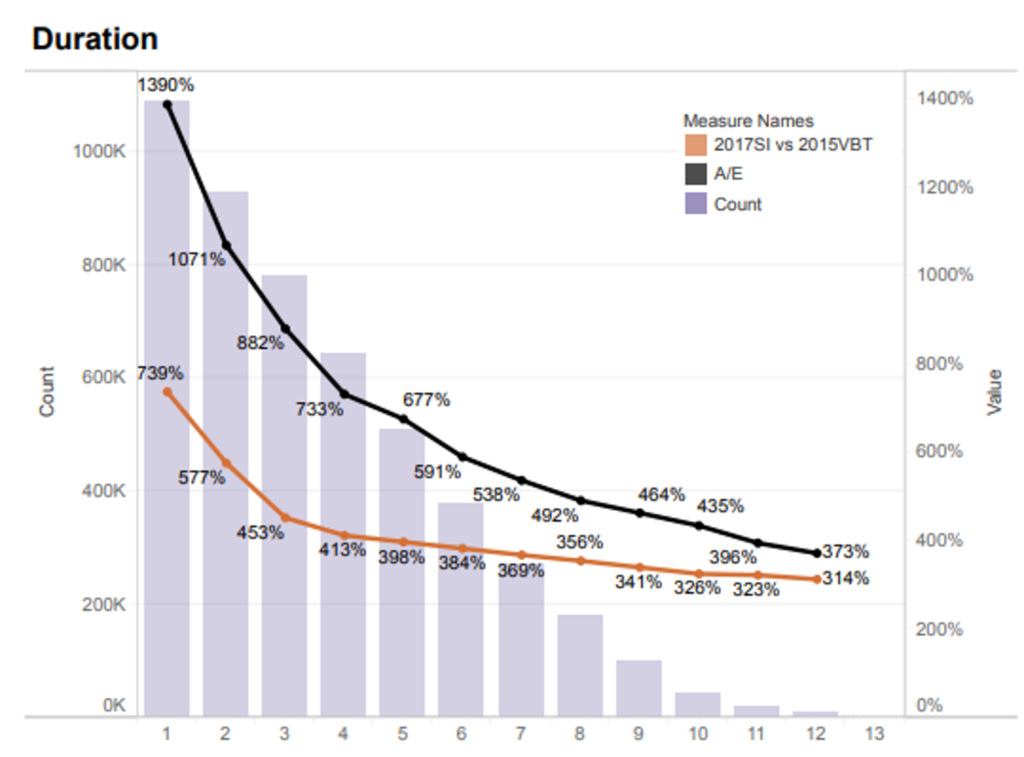
Figure 1: Male Declinable Risk A/E by Duration, Decline Mortality: Shape and severity of mortality for declinable life insurance risks Note that Decline A/E analysis (black line) were adjusted to exclude policies which were rescinded / contestable in the first two years.
A present value analysis also found that the relative decline mortality can range from approximately 400-800% across term products and gender groups. For example, Term 10 product for Female was found to be on the higher end of that range, highlighting the potential implications for pricing.
While the Canadian market may have varying demographics and distribution channels, research highlights the importance of understanding the severity of decline mortality and its shape and timing.
What are some alternatives in light of limited data availability in Canada?
Although there is no clear approach to compare and assess industry decline mortality data in Canada, each carrier can leverage their own data to better understand their exposure to decline risk. Some examples include monitoring decline rate trends, reasons for decline, reviewing audit findings, as well as early claims experience.
As underwriting data sources evolve, including clinical lab results, prescription and health records, and family history, carriers may also be able to incorporate these data into predictive risk scoring frameworks. This could help develop proxy measures for both the severity and timing of decline mortality.
As carriers continue to assess and monitor potential decline risk within their AUW programs, additional data would support broader industry studies in Canada. In the meantime, lessons from the more mature US market can provide valuable directional insights for Canadian underwriting and pricing decisions.
What are some practical steps for Canadian carriers to mitigate risk of decline slippage?
There are a few practical solutions for carriers in Canada to better assess and manage decline risk:
- Underwriting review of rated and decline cases
- Monitor decline mortality trends
- Conduct early claims studies
- Refine decline mortality assumptions
- Benchmarking relative to industry
For many carriers, the challenge is not only mitigating decline slippage, but establishing effective monitoring frameworks that can evolve alongside their AUW programs and risk profiles.
Contact Us
As AUW continues to expand in Canada, understanding and monitoring decline mortality will be increasingly important to inform underwriting and pricing decisions. Please contact us to discuss decline mortality risk and evolving considerations for Canadia AUW programs.
Contributors
Jason Lim, AVP, Business Development, Life & Health Canada
Ehren Nagel, VP, Actuarial Innovation, US Life
Opinions expressed herein are solely those of the author. This article is for general information, education, and discussion purposes only. It does not constitute legal or professional advice and does not necessarily reflect, in whole or in part, any corporate position, opinion or view of PartnerRe or its affiliates.
References
[1] https://www.partnerre.com/perspectives/the-state-of-mortality-slippage-a-canadian-market-view/
[2] Decline mortality data was derived using a declinable risk proxy based on extensive death dataset. Refer to our PartnerRe whitepaper for more details: https://www.partnerre.com/perspectives/decline-mortality-shape-and-severity-of-mortality-for-declinable-life-insurance-risks/
[3] https://www.partnerre.com/perspectives/decline-mortality-shape-and-severity-of-mortality-for-declinable-life-insurance-risks/
